Break-Even ROAS: Formula, Example and E-commerce Calculator
Calculate break-even ROAS from contribution margin, see how VAT changes reported ROAS, and use a free e-commerce calculator.
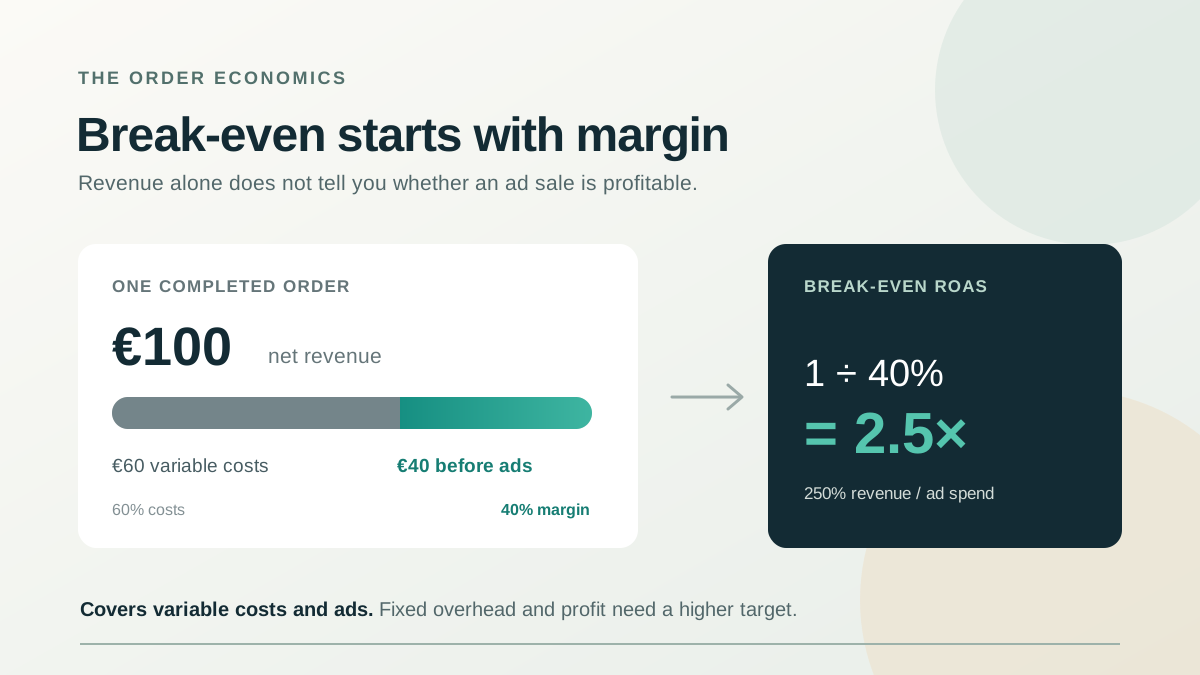
Break-even ROAS is the revenue-to-ad-spend ratio that leaves zero contribution after variable costs
Divide 1 by your contribution margin before advertising. If €40 remains from every €100 of net sales after variable costs, your break-even ROAS is 1 ÷ 0.40 = 2.5, or 250%. At that point, the order covers its variable costs and advertising. It still contributes nothing to fixed overhead or profit.
What ROAS measures and what break-even adds
ROAS means revenue attributed to advertising divided by advertising spend. A reported ROAS of 300% means €3 of tracked revenue for each €1 of ad spend. Break-even ROAS asks a different question: how much tracked revenue is needed to cover ad spend at your actual margin? There is no universal “good ROAS” because contribution margins, returns, shipping and tax treatment differ by store and product.
Calculate contribution margin before advertising
Start with the order revenue excluding VAT. Subtract the variable costs that change when you make and fulfil that sale: product cost, packaging and fulfilment, shipping you pay, payment and marketplace fees, and the expected net cost of returns or refunds. Use a consistent tax basis for every amount. The remainder is contribution before advertising. Divide it by net revenue to get the margin used in the formula.
Worked example: a €100 order with €40 contribution
Assume an order brings €100 net revenue. Product cost is €45, delivery €8, payment fees €2 and expected return costs €5. That leaves €40 before advertising, a 40% contribution margin. Break-even ROAS is €100 ÷ €40 = 2.5, or 250%. At €40 of ad spend, the order leaves zero after variable costs and advertising. Rent, salaries, software and desired profit are not included.
| Order component | Amount |
|---|---|
| Net revenue | €100 |
| Product cost | −€45 |
| Delivery | −€8 |
| Payment fees | −€2 |
| Expected return costs | −€5 |
| Contribution before ads | €40 |
| Contribution margin | 40% |
Calculate a target ROAS above break-even
Break-even is the zero-profit floor. To reserve part of revenue for overhead and profit, subtract that desired share from the contribution margin before dividing. Target ROAS = 1 ÷ (contribution margin − desired post-ad share). With a 40% contribution margin and a 10% desired share, target ROAS = 1 ÷ (0.40 − 0.10) = 3.33, or about 333%. The desired share must be lower than the contribution margin; otherwise the target cannot be met under these assumptions.
Keep VAT and reported ROAS on the same basis
The example uses revenue excluding VAT. If your store sends gross order value to an ad platform while your margin calculation uses net revenue, the platform can show a higher ROAS than your economics support. For illustration, at a hypothetical 20% VAT rate, €100 net sales become €120 gross. With €40 ad spend, gross-value reporting shows 300%, while net revenue gives 250%. Standard VAT rates differ across markets and products; the table gives a few examples. In the United States, sales tax is set at state and local level, and collection obligations can depend on where your business has a tax nexus. Use the rate and tax basis that apply to the actual order and your conversion setup. Confirm the treatment with your accountant.
| Market | Standard tax rate |
|---|---|
| Germany | 19% VAT |
| Austria | 20% VAT |
| France | 20% VAT |
| Spain | 21% VAT |
| Switzerland | 8.1% VAT |
| United States | State and local sales tax varies |
European Commission — standard VAT rates in EU countries
Swiss Federal Tax Administration — VAT rates
U.S. Small Business Administration — state and local sales tax
Different products need different ROAS floors
At a 60% contribution margin, break-even ROAS is about 167%. At 40%, it is 250%; at 20%, it is 500%. One store-wide target can therefore steer spend toward products that produce more tracked revenue but less contribution. Group products by margin and use category-level targets where your data supports them. Alternatively, pass a business-relevant conversion value such as profit margin rather than identical revenue values.
| Contribution margin | Break-even ROAS |
|---|---|
| 60% | 167% |
| 40% | 250% |
| 25% | 400% |
| 20% | 500% |
Google Ads Help — Value-based Bidding Best Practices
Use the calculator to estimate your own threshold
Enter a typical order value excluding VAT and the variable costs per completed order. Add your applicable VAT rate if the platform records conversion value including VAT. The calculator estimates contribution margin, break-even ROAS and a target ROAS for the profit share you choose. It is a planning estimate: use average realised costs, account for refunds and discounts, and check the calculation with your finance team before changing bidding targets.
Break-even ROAS calculator
Estimate your margin and the ROAS needed to cover advertising. Enter values per order, excluding VAT unless stated.
- Contribution before ads
- Break-even ROAS, net value
- Break-even ROAS if tracked revenue includes VAT
- Target ROAS, net value
- Target ROAS if conversion value includes VAT
Planning estimate. Gross-value ROAS assumes tracked order value includes VAT while the ad spend is treated as entered. VAT recovery and ad-invoice treatment may differ; confirm with your accountant.
What ROAS is good for an e-commerce store?
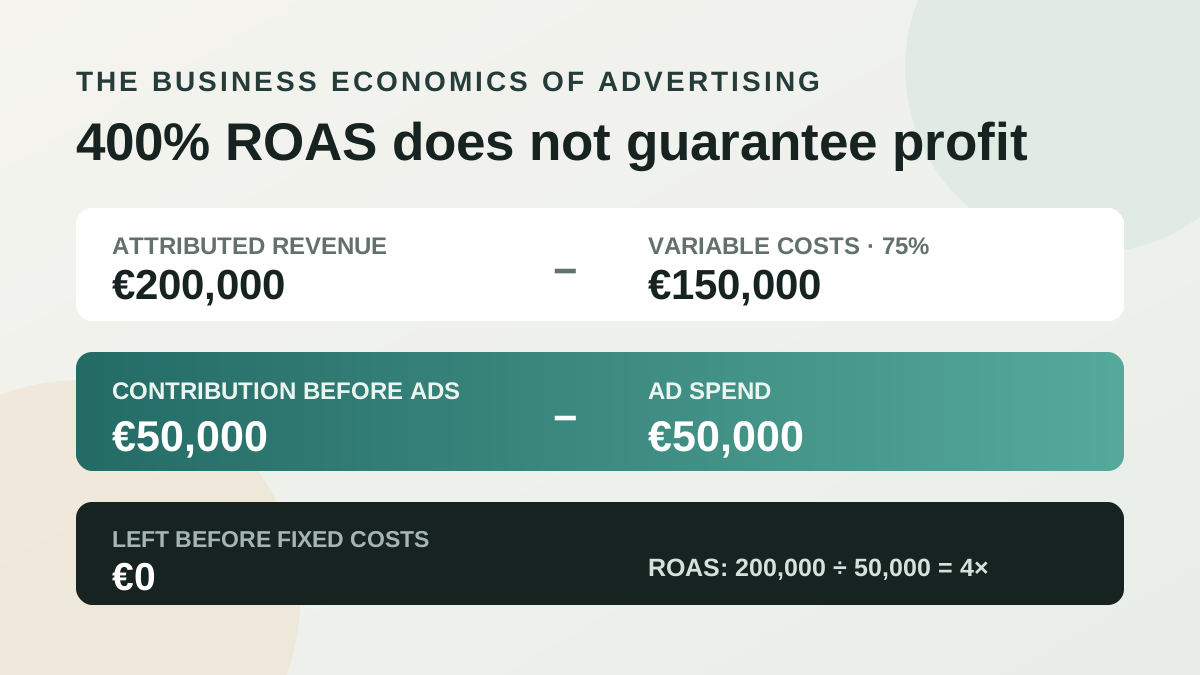
A good ROAS is above your target ROAS, not a fixed industry benchmark. The target depends on product margin, variable fulfilment costs, returns, tax basis and the profit you need after advertising. A 400% ROAS can be profitable for one category and below break-even for another.
What is the difference between break-even and target ROAS?
Break-even ROAS covers variable costs and advertising, leaving zero contribution afterward. Target ROAS also reserves revenue for overhead and the profit goal. It should be higher than break-even when that profit share is positive.
Can new customers be acquired below break-even ROAS?
Sometimes, when repeat purchases create measurable future contribution and the business can fund the payback period. Model cohort margin over a defined time horizon, including retention, discounts and fulfilment costs. A low first-order ROAS is not automatically profitable just because lifetime value is assumed.
How AdsWaves uses break-even ROAS
We calculate contribution margin by product group, check how conversion value is sent to Google and Meta, and compare campaign performance with the economics behind each sale. The result is a practical floor and target for budget decisions, with assumptions made visible.