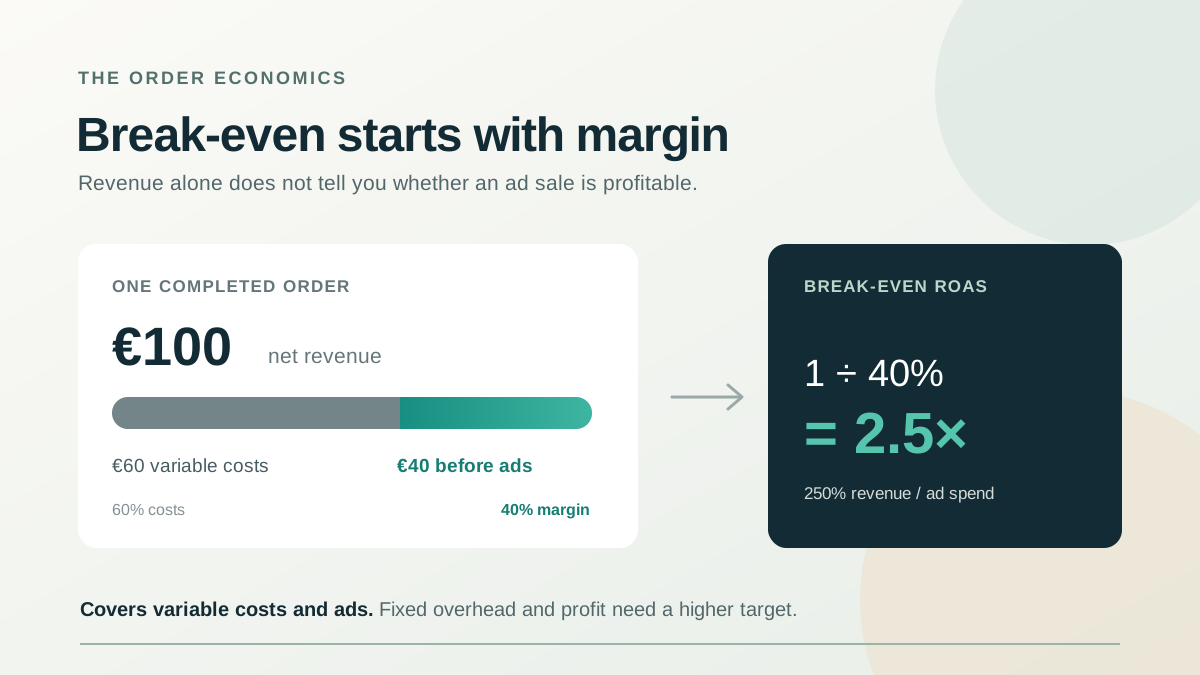
Your ROAS Is Growing. Why Isn’t Your Business More Profitable?
A higher ROAS can hide weak margins, low-quality leads and sales that were not caused by ads. Learn which business metrics to check before scaling.
ROAS is not profit
The most dangerous performance marketing mistake is optimizing advertising for metrics that do not reflect the real economics of the business. You can cut cost per lead by 40%, double conversions and present an impressive ROAS to management while making the company’s financial result worse. That happens when advertising efficiency is treated as a substitute for profitability.
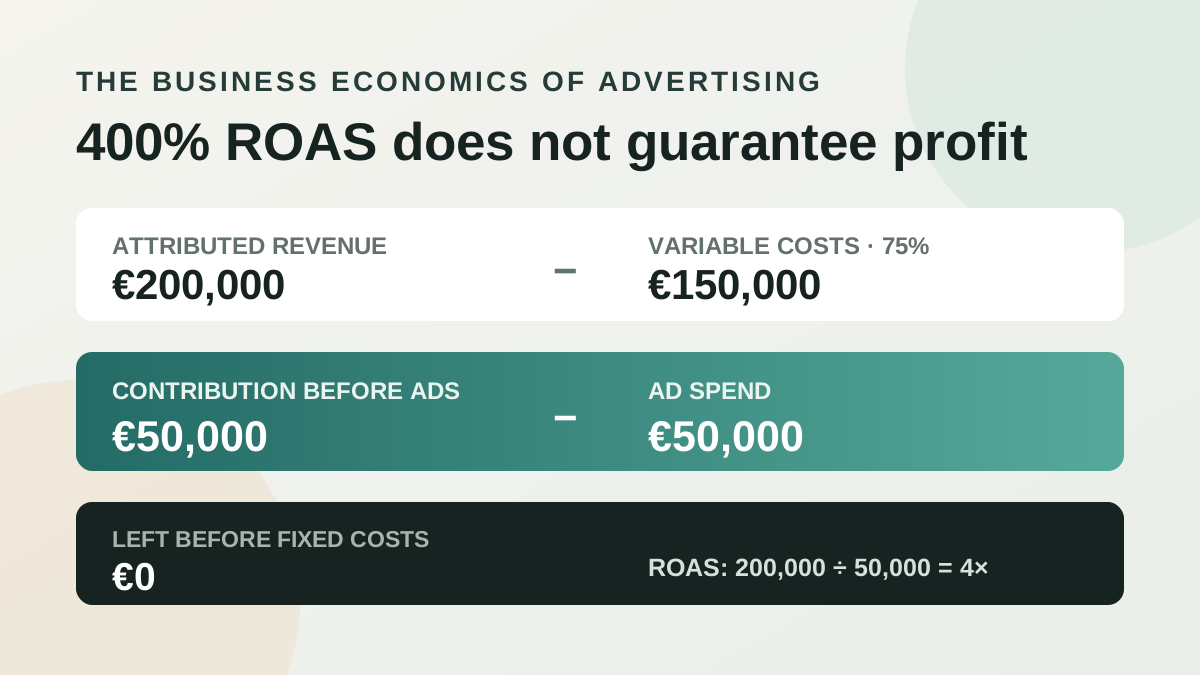
Consider an online store with €50,000 in ad spend. The platform reports €200,000 in revenue and a 400% ROAS. If product cost, logistics, payment processing and returns consume 75% of revenue, contribution before ads is €50,000. After the ad spend, €0 remains—before fixed costs.
| Measure | Amount |
|---|---|
| Attributed revenue | €200,000 |
| Variable costs (75%) | −€150,000 |
| Contribution before ads | €50,000 |
| Ad spend | −€50,000 |
| Remaining before fixed costs | €0 |
Google Ads Help — Value-based Bidding Best Practices
Cheap leads can become the most expensive customers
This problem is especially visible in B2B. Marketing reports a €30 cost per lead and hundreds of form submissions. But most contacts do not match the ideal customer profile (ICP), have no budget or lack decision-making authority.
Compare two channels with the same €12,000 budget. Channel A brings 400 leads at €30 each, but only 4% are sales-qualified leads (SQLs). Channel B brings 100 leads at €120 each, and 30% qualify. If one in five SQLs becomes a customer, A produces about 3 customers and B produces 6. Marketing optimized for completed forms; the business needs qualified pipeline and contracts.
| Measure | Channel A | Channel B |
|---|---|---|
| Leads / cost per lead | 400 / €30 | 100 / €120 |
| SQL rate / qualified leads | 4% / 16 | 30% / 30 |
| Customers at 20% close rate | ≈3.2 (about 3) | 6 |
Attribution is not the same as incremental growth
An ad platform may claim a conversion that would have happened without the ad. Someone who already knows a brand may search for its name, click a paid ad and buy. The platform records the sale, but that does not prove the ad caused it.
This is the difference between attributed revenue and incremental revenue. If only one in ten sales claimed by a brand campaign is truly incremental, its cost per incremental sale can be roughly ten times the platform’s reported cost per sale, assuming spend and other factors stay the same.
Conversion Lift can estimate incremental impact through a controlled group that sees ads and a control group that does not. It is not available for every Google Ads account; Google says to contact an account representative. Marketing Mix Modeling (MMM), including Google’s open-source Meridian, can help assess channel contribution across a broader period. These methods answer different questions and depend on suitable data and study design.
Google Ads Help — About Conversion Lift
Google for Developers — Meridian
What the business should measure
Evaluate performance marketing at three levels. Operational metrics show how the ads are running. Commercial metrics show whether they create valuable opportunities and customers. Financial metrics show whether the resulting growth is profitable. Budget decisions should ultimately use the financial level, not the operational level alone.
| Level | What it tells you | Example metrics |
|---|---|---|
| Operational | How advertising is running | CPC, CPA, CPL, conversion rate |
| Commercial | Whether it creates valuable opportunities and customers | Qualified pipeline, CAC, LTV, CAC payback |
| Financial | Whether growth creates profit and cash | Contribution margin, incremental profit, cash flow, marketing payback |
Our forecast for 2027–2028
Our forecast: competitive advantage will depend less on manual bid management and more on customer data quality, CRM integration with advertising platforms, and the ability to measure incremental profit.
Algorithms will continue to improve. But they cannot optimize for a business outcome the company does not measure and feed back accurately.
How AdsWaves approaches growth economics
Fifteen years in performance marketing have taught us a simple principle: scale economically sustainable growth, not traffic.
At AdsWaves, we assess campaigns through the client’s business model: contribution margin, acquisition cost, conversion quality and realistic room to scale. Traffic is the last step, not the first.
If your ad account reports strong results but profit is not growing, start by auditing the metrics that actually guide your advertising decisions. AdsWaves focuses on growth economics, not advertising metrics alone.
What does a 400% ROAS tell you about profit?
By itself, nothing definitive. ROAS compares attributed revenue with ad spend. Profit also depends on contribution margin, other variable costs, fixed costs and whether the sales were incremental.
How can I tell whether leads are valuable?
Connect the CRM to your measurement setup and return qualified lead and sales outcomes to the ad platforms where appropriate. Compare channels by qualified pipeline, customers and acquisition cost, not form submissions alone.
How do I measure whether advertising caused extra sales?
Use an incrementality experiment such as a suitable Conversion Lift study, or an MMM approach when the data and business scale support it. Platform attribution alone does not prove that the advertising created the sale.